Thursday, October 11, 2012

Santiago de Compostela (Oct 11)

We started off when there was just enough light so that we could cover the last 9 km of our long journey and arrive at Santiago in time for the daily mass at noon.

Last night there was a period of very heavy downpour and we wondered if that would accompany us today. It was drizzling as we left and of course when we got to Monte do Gozo at the outer edge, Santiago was hidden behind a veil of mist and rain.

Soon we were venturing into the urban streets of Santiago and as in any other cities we dodged the cars and raced across pedestrian crossings. No worries about cow dung piles anymore!

Up a gentle slope, through one of the gates to the old town (Porto Do Camino) and we were there in Prazo Obradoiro and in front of us, the end of our journey, the end of the Camino de Santiago, was the Cathedral of Santiago de Compostela.


We had more than an hour before the daily noon mass so our first call was to the Pilgrim's Office to have the last stamp on our credentials and receive a certificate of our achievement. The document was in Latin (we would need to read tbe translation but we are sure it said something nice). K's name was entered in the Latin form of Catuarinam whereas mine was wisely left alone in the original form by the lady who received me. We gladly accepted their congratulations.

We left the office and returned to tbe Cathedral for the mass (held in Spanish of course) and the spectacular and eagerly awaited swinging of the giant incence burner.

Outside in the Prazo the crowd resembled a post graduation ceremony celebration. Even the sun came out behind the clouds, briefly.

(This completes the blog but it will be updated with some photos and edited to improve content. For new  postings please revert to http://reshui.blogspot.com)

Wednesday, October 10, 2012

Salceda to Vilamaior (Oct 10)

At Salceda we were just 29 km from Santiago. We booked accommodation at Vilamaior so that we will have only 9km to walk into Santiago on the next morning.

The morning was glorious by Galician standard - it was not raining. Passing the village of St Irene after a few hours walk we entered a forest that touched us with nostalgia - eucalyptus trees, with the same powerful scent of the oil but trees here were much taller and lushier.

The euphoria for the absence of rain was shortlived. The drizzle came and it became more like intermittent rain. A British type weather one might say; I was told there was a connection in more than one way between Galicia and Gaelic countries of Britain and Ireland further north, for they shared the Celtic past. Of course there are better sources on the internet regarding this bit of history.

Later as we went over a hill nearer to Vilamaior we had the distraction of the noise of aircrafts taking off for we were passing the runway of the Santiago airport. Earlier we had sent a message of bon voyage to Sue and Dave who were flying off from there. In a few days it would be our turn!


The last 5 km to Vilamaior seemed to take ages like it always did at the end of each day. There was a steep hill to climb after the penultimate village of Lavacolla. As we struggled on in the rain we thought we pondered on the reasons why so many Galicians had emigrated as the guidebook told us - must be the weather! Of course in actual fact it was a whole lot of other factors including poverty in the recent past.

When we finally arrived and shown to our room it was literary a warm feeling. The owner had very thoughtfully turned on the heater on a full blast. Before long my wet pants were dry and the wet weather forgotten - for today.

Arzua to Salceda (Oct 9)

We had a short day, just as well. It would have been be difficult to handle the wet over a longer distance. The intermittent drizzle and rain (rain usually returned as soon as we put our poncho away) and soggy ground made progress slow. A village passing by wished us "bueno diaz"  (good day) and K muttered "glad it's good for you".


As we got near Salceda we followed a hand painted sign on the asphalt telling us that the hotel and albergue accommodation we booked for was in a direction away from the Camino route, down a side road on the other side of the main road, quite contrary to the indication on the guidebook map. We followed it for half a kilometre or more before we decided we must have been mistaken and returned to the Camino route. We had been warned that there were instances of practical jokes being played on pilgrims.

A kilometre further we came to an attractive roadside tavern and decided to have lunch there. It was a saver for the otherwise miserable day (mainly due to the weather).  The entree dish of wild mushroom with egg was unusually non-traditional and good but we did wonder where the mushroom came from having seen an abundance of them in the woods. The main courses of fish (hake) and minced pork were good too.

After lunch we asked the publican where our booked accommodation Pousada de Salceda was, he said he would ring for the transport as it was a kilometre away. The transport came and we were brought down the road we were previously heading and continued on a little further. The surprise was it was a modern resort type accommodation that not only had dormitory beds alberque style but also rooms with very modern finishing. Restored from an old stone building it was warm and dry, and very much what we meeded after the very wet day. Another Lestedo type experience!

Tuesday, October 9, 2012

Lobreiro to Arzua (Oct 8)

When we were leaving Lestedo, I asked the Galician manager which were the wet months in Galicia. He said in Galicia it rained every month of the year and every day each month. Since we already had a few days of fine weather our luck would soon run out. So it was not surprising that it was drizzling when we left Lebreiro morning and it continued intermittently throughout the morning. When the rain stopped it became uncomfortably warm and humid.

We passed through much the same terrain but the tracks were more even. We wanted to call in at the local tourism office at the major town of Melide to find out more about the services we could expect to have in Santiago on Sunday Oct 12 (our free day in Santiago after our arrival there) for we had just discovered that it was the important St Columbus Day, a public holiday all over Spain. Before we knew it, the Camino had taken us out of the town without passing any tourist office and we were unwilling to walk back into town. We also missed tbe main church where we had hoped to get a stamp on our credentials. But we did not miss seeing the series of restaurants serving pulpo that the town was famous for.


Another 5 km on at the village of Boente, the local priest was on duty as the guidebook said he normally would, meeting pilgrims, giving blessings and stamping their credentials. In fact he was the first Catholic priest we have met after over nearly 40 days of walking. On reflection, over the past few days in Galicia, we have noticed that Galicia was rather deficient in fine restored churches that we had come to expect in each village and town in Castilla and Navarra provinces, and where even small villages had some very important religious links to the past. It wss a bit of history that we had not totally understood.  Still, the province impressed with it lushness and natural beauty (when the rain and forests were not hindering the view).

Just before Arzua, we saw a moving sight. Four young men vigorously pushing a sick youth on a mobile bed along the Camino route. The sick youth must wished to go on the Camino.


We wanted a more comfortable day after yesterday's surprisingly tough 14km but the location of towns and quality of accommodation were such that we ended up having to do more than 20km or so. The stop we chose was in fact beyond Arzua, which at the end of the day was always a struggle.

The hotel we stayed in was a disappointment. It was one of those that we could sense the moment we walked in that our washings would not dry! In fact the heating equipment was leaking water into the room that surely made the matter worse. The restaurant had a good menu but my steak was not defrosted properly before the chef cooked it and I had to have it sent back. Not a good ending to the day except that we had good news from our friends Sue and Dave that they had arrived at Santiago, mission accomplished!  They started at Sarria a couple of days before we got there.

Lestedo to Lobereiro (Oct 7)

 It was such a pleasure to stay at the Rectoral de Lestode and we made a point of sleeping in after the previous day's long walk. We woke to a very nice breakdast (more than just toast and coffee, we even had fruits, spanish sausages and Santiago cakes).

At Lestedo we were about 73km from Santiago. It was time to plan the walk into the ultimate destination. The young and enthusiastic could do it in 2 days but given what we were capable of doing and wanting a 10 km half-day leisurely walk into Santiago on the final day, we settled on a 5 day final journey instead.

A few kilometres from Lestedo we reached at the fringe of Palas de Rei where we had a long stop to use at the facilities of the local municipal albergue, including their internet and cafe. (Lestedo was so small that it had no internet connections).  It was interesting that many alberques had very good facilities that included facilities for washings and the internet, but not more personal space which we preferred.


12th century church at San Xulian.
Though we set ourselves just 14km day it was tiring because of the ups and downs over numerous small streams and rivers and the hot and humid conditions of the wooded terrain. We were relieved when we finally arrived at the the casa rurale we booked at Lobreiro, a renovated country house run by a kindly woman and her family. She quickly told us that it being sunday there would be no cooked meals anywhere in the small hamlet. However the entreprising lady also ran a small cafe at tbe back of the building in a semi temporary shed that served a good jamon boccadillo.

Sunday, October 7, 2012

Portomarin to Lestedo (Oct 6)

Leaving Portomarin we went up a gradual incline to a peak that was hardly discernible. Many walkers leaving Portomarin head for the major centre of Palas de Rei but the 25km would be too difficult for us so we looked for a closer day destination. Instead, from a list suggested by our comfortable hotel at Sarria, we picked to stay at a place located at the quiet hamlet of Lestedo, a mere 20km away. We were secretly pleased that by that stage of our walk, we were able to consider 20km as acceptable distance.

The weather forecast in the morning was unfavourable but the wet did not eventuate apart from a few drops. In fact the overcast sky with gentle breeze should be ideal for walking and the terrain throughout the day was green and gently undulating with forests and tree-lined tracks. StIll we struggled a bit, probably because we were not used to consecutive long days. We had lunch at a quiet cafe (jamon and boccadillo of course) and felt better after that.

Sign near Ligonde says Pilgrims' Cemetery but we could see any graves.


As usual we met other walkers on the way. With most we were too engrossed with walking to exchange more than "Buen Camino" or even just an "hola", but with some we chatted. A Venezuelan now living in the US asked us where we came from etc, and when I said I grew up in Singapore, he immediately said he used to sell sardines for the Ayam brand of the canned fish!  (Singaporeans reading this will know the brand well). We sometimes got surprises like that.

With the denser population, the hamlets in Galicia were getting closer together as we approached Santiago, and while they appeared as distinct markings on the map, they were not easily identified. As we walked on, it was often hard to keep track of where we actually were. With the frequent ups and downs of the tracks, we could not tell the change in elevation and the peaks marked on the map were often as distinct as we expected. It was not until we saw the sign for Ligonde village that we knew we were nearly at our day's destination.

The place we booked to stay at Lestedo was converted from an old pilgrims' hospital. When we stepped in, we had the biggest surprise. Instead of simple hostel that we had got used to and had come to expect each night, we found ourselves in a modern resort type accommodation with modern furnishing that reminded us of some of the restored palaces we stayed in in India earlier this year. Dinner was good, a simple but well prepared mushroom and tomato paste dish for first course (K had the traditional salad), while our main course of salt crusted oven baked chicken was delicious. For dessert, we had whisky cake ice cream. Some pilgrims could be embarrassed by the luxury of it all, but we enjoyed all that.

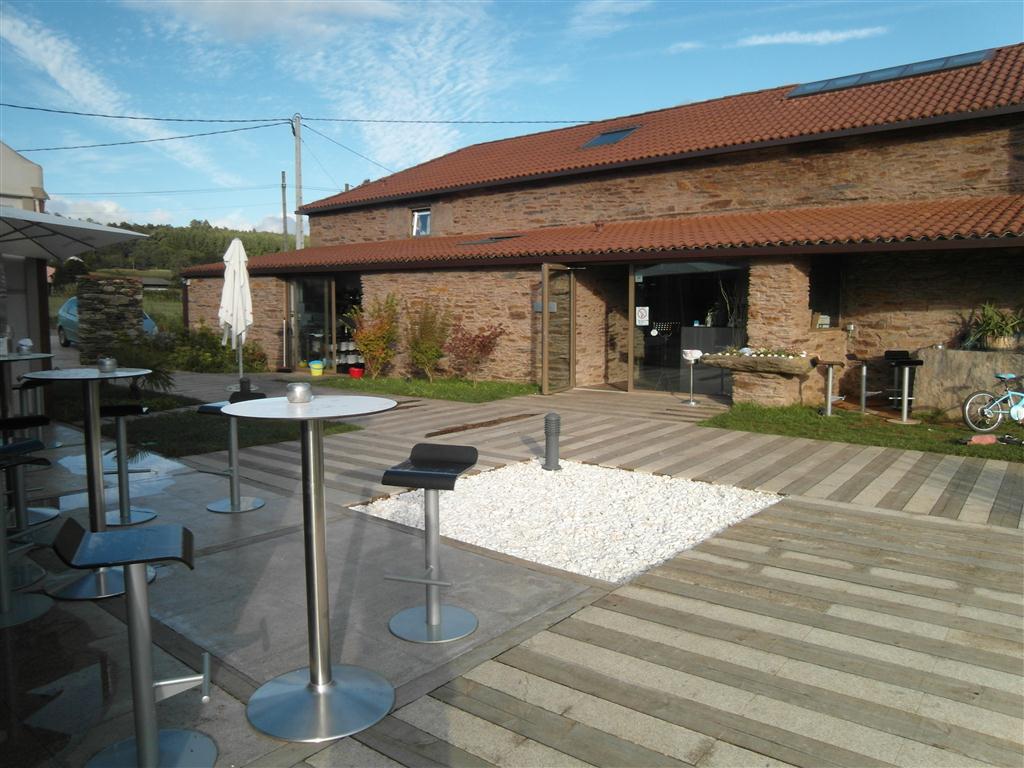
Where we stayed at Lestedo.

Sarria to Portomarin (Oct 5)

We planned a long 22km day involving a climb to 660m and then a drop of 300m to the little town of Portomarin. Even though the long day and ups and downs were strenuous, the scenery was rewarding with green pastures interspersed with forests of chestnut, oak and birch trees. With the higher rainfall, the trees are tall in this part of Spain.


Sarria at just 110km from Santiago is the starting point for a lot of people because  the rule for qualifying for a compostela (certificate) at Santiago required a pilgrim to walk the last 100km at a minimum. The new starters have the freshness and many zipped past us with much energy and enthusiasm!

The 100km mark was a highnote for us for it marked the finishing stretch. Until the numbers were reasonably small, the final destination was quite incomprehensible, as though we had a fear of not finishing. Now, with just 100km, we were actually looking forward to it.

We posed for photos in front of the stone marker when we came to it only to discover later that it was not the correct marker and that a prankster had cheekily altered the sign. The real one came a few hundred metres later!

The 100km mark.


The bridge over the river Mino at the entrance to Portomarin was spectacular for its height over the dry river bed, quite threatening for those fearful of heights. In fact K chose to walk on the traffic lane rather than the pedestrian path so as to be further away from the railing.

Compared to other towns and villages, Portomarin was lacking in old buildings. Some years ago, it was shifted to higher grounds when a dam was built. The old church in the centre of the town was reassembled stone by stone at the new spot. We remain puzzled by the lack of water in the "dam" that the high bridge now crosses over.

Triacastela to Sarria (Oct 4)

Being in a valley, our room at Triacastela was cold and damp and it was too early in the season for the heating to come on. When we started out nearly 9am the sun had yet to appear above the surrounding mounains, it was freezing cold and the ground around looked frosty.

We climbed out of the valley through a rain forest and then cow pastures. The village of San Xil was not unlike the dung coated Fonfria of the previous day only that the path was steeper, and with a careless slip one would end up covered in cow excrement! Needless to say we were pleased to move on to still higher grounds, once more into forests of oak, chestnut and birch trees.

Birch forest near Triacastela.


The rest of the walk was through similar landscape of forests and pastures, a scenery of beauty except that one had to constantly watch one's feet from stepping on the even ground or cow dung!

Walking towards Sarria we were joined by a Dutch lady we met several times after Cebreiro, over the past couple of days. While chatting as we walked we discoveded we had some common background. She actually went to school in Singapore while her father was working in Java. What's more her father was working in Batu near Malang, a very little known hill resort outside of Dad´s home town of Surabaya in East Java, where we happened to stay in some years ago.

After Triacastela, we were determined to be comfortable at Sarria so we stayed at a 3-star hotel. The hotel had a "3-fork" restaurant, which we eagerly dined in. K had their pork dish in the "menu del diaz", which was always good value, and I had turbot and clams casserole even though I had never heard of the fish before. Quite a change from a diet of jamon and tortillas.

Sarria was a prosperous looking small city. We took a walk through the new part of town and topped up on our shopping needs.


Thursday, October 4, 2012

Cebriero to Triacastela (Oct 3)

Morning fog at Cebreiro.

 The casa rurale we stayed in at Cebreiro was very comfortable; though the room was small, it was
well heated.


In the morning there was just one place open for breakfast and it was served by just a single tender. The queue was long and once again we expressed surprise at the lack of interest in the service industry in
a country with 25% unemployment!

The winds from across the Atlantic hits land at Galicia making its weather wet and unstable throughout the year. True to form the weather changed that night and when we left in the morning Cebreiro was shrouded in fog and drizzling. Out came the ponchos for the first time, as well as oil-skin gaiters.

The downhill walk was not as difficult as expected but we were still cautious, taking the road in parts in preference over the designated path now wet and slippery,  Throughout the descent the scenery, whenever it emerged from the fog, was stunning, the green lushness not seen earlier on the Camino. For contrast though, we also had to trod through the village of Fonfria which could be best remembered as one with its main street largely coated with a centimetre of wet cow dung such that we could not but step on it. It
was such a put off that we decided to walk another 2.5 km for our coffee break.

The weather eventually fined up but we decided to skip the last few kilometre of the descent to Triacastella where it was the steepest.

Fonfria village.


Triacastela at the foot of the range had many accommodation for peregrinos. We stayed in a room at a casa rurale but unlike the one at the top of Cebreiro it was uncomfortably cold and damp, and the heaters had yet to be turned on at that time of the year. With the humidity of Galicia and the recent rains, it meant that this was one of few times when our washings would not dry.

We had a bit of time to wander around. The church was dedicated to St James (ie Santiago) and the statue of the saint was given the most prominence. It was always good to have the time to look around the
town or village we were staying in. The gentle stroll seemed to relieve the physical stress, and in a sense the walk would not dominate the mission.

Coincidentally, there were many Aussies at the pub restaurant where we had dinner. Other pilgrims we talked to always mentioned that they had met many Aussies but until then we had not. I took pride in introducing the pulpo dish to others in the bar, and was very glad that several followed me in trying out the dish.

La Portela to O Cebreiro (Oct 2)

From La Postela our next objective was O'Cebreiro a peak on the next mountain range that marked the border with the next and final province, Galicia. The Camino path ran alongside the main road, passing through a series of villages most of which had holiday type accommodation for tourists and pilgrims as accommodation at Cebreilo can be hard to come by durring peak season.

The last 600m to the top was supposed to be quite steep and as Kay did not want to risk it so I
did it alone while she cruised up in a taxi from the village of Herrerias. The first 3 km was a steady uphill but the problem was that it was uncomfortably humid as it was through with a dense temperate rain forest. The track was unmarked and for a while I thought I was lost. Eventually I came to the village of La Faba, where I came face to face with three fat cows on a narrow path! The cowherd helped shoo the cows to one side but I ended up ducking behind him for security.

Beyond La Faba the land was cleared of trees and I had a spectacular view of the mountains an valley below. The climb was not too difficult but it was incessant and slow and I needed frequent rests, including having a soup break at a bar at Laguna, the last village before the peak.

Just before reaching the peak, I passed the maker stone that told I had entered Galicia.


The top of Cebreiro is a cluster of stone buildings all part of the tourist and pilgrimage industry. There were souvenir shops, bars and accommodation. Unlike most other places we passed through, it was not dominated by a church.  The historical link to the early pilgrims seemed tenuous.

Wednesday, October 3, 2012

Valtuille to La Portela - disaster management (Oct 1)

We were packing to leave in the morning when I discovered that my wallet was missing. I could have left it at the village bar when I was paying for the previous night's dinner or it could have fallen out on the way back, a distance of a couple of hundred metres. The bar had opened in the morning but the owner said he did not have it and we checked the path we took with no success. If it was dropped, it would have been picked up by any passer by. Contained in it were some cash, credit cards and a travel card specific for foreign currency withdrawals. Fortunately we had made sure we carried only our own credit cards and we have a second travel card. The landlady was helpful and quickly prepared a report for the police with our contact numbers in case it was found, but we held no hope for that.

We finally left Valtuille after 930am and at the next town Villafranca (yes another one of tbe same name as one we came across some weeks ago) 5 km away, thankfully  a large one, I was able to locate an internet cafe where I found contact information for the banks, deactivated the travel card. 

Villafranca #2


Then we were on our way again, on a route that followed the main road N6 and the new expressway A6, through villages with timber mills (oak, chestnut and pine trees galore). There was enough chestnuts on the ground for a roasted chestnut hawker to do a roaring business.

As the roads had been realigned following the guide maps was difficult but we eventually arrived at La Portela, our night stop.We stayed at a private albergue at La Portela. It was a truckstop but the reasonably decent looking hotel across the road did not want to serve us meals even though we were there in the advertised hour. Too early, the staff said. The albergue was very friendly and the manager, son-in-law of the owner, was most helpful in getting us booked into a place at the next stop in O Cebreiro. Most useful when our mobile phones did not work properly, which happened quite often in remote villages.

Tuesday, October 2, 2012

Ponferrada to Valtuille de Ariba (Sep 30)

Leaving the urban area of Ponferrada we first passed through small market gardens but but beyond the village of Fuente Nuevas where we stopped for a break, it became vineyard country again. It was Sunday and many vineyards were harvesting. Groups of itinerent workers were picking and carrying basket loads onto the back of trucks. The owner or supervisors handed out large bunches of grapes to us passsing walkers and wished us 'buen Camino'. He must be in a particularly good mood at harvest time, certainly quite a contrast to the reception the night before. Earlier at Fuente Nurevas  a villager handed out freshly picked peaches. It was a fruitful morning indeed.

At Fuente Nuevas we met up again with the NZ couple we had come across several times, first at Rabanal, then again at Ponferrada where we had dinner together.. We often make such short acquaintances with pilgrims walking roughly the same speed.


The day started cool but it warmed up rapidly and we were glad to take a break at the town of Cacabelos. The sign outside a crowded bar restaurant declared Pulperia Compostella. Of course we were nearing Galicia province and the Galician specialty pulpo or octopus was making its appearance. It was Sunday, and the restaurant was crowded with churchgoers and we were lucky to find a table, and most were ordering the pulpo sprinkled with bright red paprika. I could not wait for Galicia to taste the pulpo and had one serving all to myself because K could hardly bear the sight of tbe chopped tentacles let alone eat them!

Pulpo for lunch.

 We contined through vineyards and stopped for the night at a casa rurale, in the tiny hamlet of Valtuille de Arriba. Like many such places we have been through the B&B was a nicely and quite newly renovated stone house. The owner was a very friendly (and entreprising) teacher of French af a nearby school.
For dinner we walked a few hundred metres to the only bar in the quiet hamlet, which must serve mainly by itinerant fruit pickers. By the time we got there, the bar was quiet and the only other customer were an Irish couple peregrinos staying at the same casa rurale.

Acebo to Ponferrada (Sep 29)

Acebo was only half way down the mountain range and after the previous day's experience we reassesed our management of the descent. We were not the only walkers feeling the stresses. A woman from Melbourne staying at the same hostal had a fall and another was nursing her injured knee at the bar. Expecting that the track down would be covered the same way with large loose stones, we decided to follow the asphalt road instead even though this was generally not recommended because the distance was greater and there were risks from passing traffic.

Nonetheless, we followed the LE241 that wound its way though the mountain valleys, carefully keeping to the narrow paths one side or the other, all the time with steep mountain face on one and deep valley on the other. Following the road we passed high above Riego de Ambros, a village in which all houses seemed to have a new slate roof. The view was breathtaking so was the thrill when cars come around the bend towards us. Fortunately it was a quiet road on a quiet Saturday.

Village of Riego de Ambros.


At the pretty town of Molinaseca we still had 8 km to go to reach our stopover town of Ponferrada where we also wanted to a walk around the well known Knight Templer medieval castle there. Something had to give, the walking did.

Medieval castle at Ponferrada.

Ponferrada did not have the same warm feeling as most other places we visited. Many walls around the old city was defaced with grafitis and the castle though massive, was no more impressive than others in Britain and Europe.

Perhaps worst of all the restaurant waiters at the main plaza were unfriendly even though the tapas dishes we had were among the best so far. We were told curtly by the waiter to speak Spainish even though the menu had an English version; we were supposed to look at the corresponding items in Spanish and order them that way. Fortunately by then, more than four weeks in the country, K had quite a repertoir in the language for ordering food and was able to revert promptly. If the waiter was impressed he did not show it!

Monday, October 1, 2012

Rabanal to Acebo via Cruz Ferro (Sep 28)

Leaving Rabanal we climbed gradually and after about 6 km we rested at a small mountain village of Foncebadon. We kept looking towards the top of the ridge for tbe Cruz de Ferro, the Iron Cross. Another  2 km on we finally came to it, a surprisingly small cross set ln top of a tall pole marking the highest elevation point of the entire Camino route, standing more than 1300m above sea level..


Many brought stones and other memorabilia from home to be placed on the base of the Cross. From us we placed a small local stone that K wrapped with a small piece of fabric that Yvonne used to wear. It was an emotional moment for us as the loss of Yvonne had so much contributed to our decision to make this journey.

Leaving the Cruz de Ferro we began the descent. There was nothing much in the 9km to El Acebo stop for tbe night apart from Manjarin, an abandoned village  populated by just one man (and a couple of cats at least) who ran a primitively constructed refuge and provided simple food and drinks on "donativo" (donation). Simple, but the shelter received mention in most guide books.

Manjarin with a population of one.


The steep descent was very difficult, made worse by the large loose stones tbat covered tbe track. Soon our knees and ankles were hurting, so at an opportunity a few kilometres from Acebo we switched to walking on an asphalt road that wound down the mountain at a more gentle slope for road traffic. Easier on the feet, not necessarily safer.

Acebo, a revived village of stone houses, is now a pilgrim village that has numerous accommodation and a bar restaurant tbat served more than the usual basic sandwiches and tapas. We had an enjoyable dinner sharing a local dish of sausages and pork leg stewed with paprika and chickpeas.

Saturday, September 29, 2012

Astorga to Rabanal del Camino (Sep 27)

It was good to finally leave the highway after Astorga and even better that our long walking day (for us that is anything more 20km) coincided with cool morning. There were several reasons for the more pleasant weather; we were another month towards the cooler period of the year, but at the same time we were gradually ascending to higher altitude.. We passed several small villages and just as it got warm in the middle of the day we headed into yet another oak forest.

Our next destination for the night Rabanal del Camino was surprisingly interesting. We were desperate for a cup of tea and so we were immediately attracted to a new, professional prepared sign proclaiming a taverna with "Italian cuisine" in English. We ordered tea and was suprised to  be served with an empty teapot containing a tea bag, a jug of hot milk and no water. And the tea was green tea. We should know better to order tea in a country better known for coffee! We did not return to the bar for another drink not just for that reason alone but the village was built on a steeply sloping land and our hostal was right on the top of the hill. We did not want to have to repeat the climb again.

We were also surprised to find that tbe restaurant at our accommodation not only stay open at our hours but actually received mention in the Michelin guide. The fish and seafood soup in the "menu del diaz" was remarkable as was the stew.


After dinner we attended part of the vesper run each night by the local Bendictine monks for pilgrims; the Latin service was supplemented by readings in a number of languages by pilgrims from a number of countries. We were not present for it but the monks also bless stones that some pilgrims carry to be placed at the Cruz de Ferro, the iron cross on the highest elevation point of the entire Camino now just half a day's  walk away.

Astorga (Sep 26)

Villadangos was one of half a dozen or so small communities that lined the original Camino route in parrallel with the busy main highway N120 between Leon and Astorga, which was why some walkers choose to use a longer alternate and more scenic route of recent creation. We chose to get over this uninteresting stretch by busing down the highway some 14 km to Hospital de Orbigo where I made my way back on the Camino track and Kay continued on to Astorga.

Oak trees and acorns.


I had some trouble finding my way to the Camino initially and ended up walking along the busy road for some distance with cars zooming past me at 80 km/h or more. I was about to turn back when a truck driver kindly indicated to me to carry on as I was indeed on the right track. Eventually I was able to join the alternate route that veered away from the highway, past a quiet village and then over a couple of hills and through an oak forest. From a lookout I was able to see Astorga and beyond that the ridge we would have to ascend in the next few days.

Astorga is a very attractive touristy town that has not just a cathedral but also a Gaudi designed mansion to its name. It prides itself to a range of local specialties in confectionary and for that reason has a large number of chocolatiers. Busloads of tourists descend on the town each day, described disparagingly by some as tourigrinos, tourist visting the Camino sights by buses. Of course whoever we are we have impacts on the community, both positive and negative.

Now in a more touristy place, we have found that more English were spoken by the storekeepers and more shops were open during the afternoon. Happily for us, we were able to find a restaurant that was open all day!

Town square at Astorga.

Tuesday, September 25, 2012

Leon to Villadangos (Sep 25)

When I referred to Leon's wide streets and pavements, it was that of the new town.  Behind the main thoroughfare of the old town where our Hotel Paris was located was a maze of winding narrow streets of shops, restaurants and bars that come alive after sunset.

Ahead of Leon, the distances between places to stay were such that we had to choose between a long day of walking or two short days. The change in the weather helped us make the decsion. Short days would allow us to cope better with the anticipated wet day, and especially the climb ahead since we had come to the end of the meseta.

Right on cue light rain began falling as we made our way out of Leon by following the yellow arrow signs painted onto pavements, drainpipes and sometimes smack in the middle of grafittis.

We made two stops at bars to dry off over cups of tea. Beyond the outer suburb of Virgen del Camino, without the shelter of the urban buildings we were soon exposed to very strong winds and driving rain. Our Gortex jackets did not protect fully and by the time we got to San Miguel we were cold and damp.

Storks' nests on church.


We had done more 10 km and our destination was only the next village but with the difficult weather we decided to catch the bus. Fortunately the main road followed the Camino route and we were able to find a bus stop quite easily.

It was a bit of a comedy when the bus arrived because we told the driver our destination was Villadangos when in fact our accommodation was 2 km before the village in a new largely industrial  neighbourhood. We rushed to alight when we spotted it, over the protest of the driver who was yelling to us that it was not our stop.

Our hostal was basic, located above a bar with little around just a petrol station next door and another pub 500m away. We had gone from the 3-star Hotel Paris in Leon to a truckstop! Still, it was clean, had good hot water and free wifi to the room, a friendly bar tender and a pretty stamp for our credentials. All we ever needed as pilgrims..

Monday, September 24, 2012

Leon (Sep 24, Day 25)


A cold and windy morning in Leon and our clean and unused warm clothings were out for the first time for weeks.

Leon was a pretty city in the bright crispy morning with its wide streets and pavements. We spent some time at the main Cathedral, a massive gothic structure that invites comparison with one in Charters in France and of course the rival city Burgos.  We could see why some purists think that Leon's was more of a place of worship while Bugos' was more a museum.

We walked several blocks to the Paradors hotel made famous by the comment of Jack of Ireland in the movie "The Way", that no self respecting pilgrim would stay in it. We didn't but we did have a capuccino each and shared a serving of ice cream. A lovely hotel created out of an old monastery that could inspire the comment: why was a monastery so grand?


Sunday, September 23, 2012

Burgo Raneros to Mansila de las Mulas then Leon (Sep 23, Day 24)

We left Burgo Raneros in the morning under an heavily overcast sky and gusty winds. After our complaints over the past weeks about tbe heat we could only be thankful about the change in the weather; indeed the cool air and good walking surface allowed us to make good progress. We were still at the meseta but the landscape we were passing through had changed, with more trees and undulating fields.

Rain at last.


There also seemed to be better facilities with rest areas every few kilometres complete with large skips for the rubbish not seen in provinces earlier. These may in the long term reduce the littering problem that spoils the route so much. There was still no public toilets around even in villages (we were totally dependent on pubs) and bushes out in the open fields invariably show evidence of previous visits!

Soon the wind became gustier and horizontal rain started to come down but luckily we were only a few hundred metres from our first rest stop of the day, having done more than 13 km.

After our rest we did another 6 km to Mansila. Our reputable English guide by John Brierley suggested that we should take a bus from Mansila to the major city of Leon without losing too much. As K said, we did not have to be told twice to skip a small uninteresting section (given the distance we had to cover in total). We headed for the autobus station only to find that being Sunday the next bus for Leon won't be due for another 5 hours.

We could stay at the cafeteria and watch the Singapore GP (yes, it was on live at the cafe too) but we were tired and a decision was quickly made to get into Leon by taxi. Twenty euros for the last 18km was a bargain.

Sahagun to El Burgo Ranero (Sep 22 day 23)

Five kilometres out of Sahagun the Camino offered two alternatives, one through a village to an old Roman road that was uneven and exposed to the elements, the other a shorter and on tree-lined "senda" (compacted sandy earth), which was easier to walk on. We took the easier route, as did most pilgrims, but someone, a villager perhaps, must have been dissatisfied with losing business from pilgrims taking the more comfortable path, had the signs defaced, diverting pilgrims to the village (and the tougher route) unless they were particularly careful in reading the maps. We stopped with a group of others and there was a lengthy pause but we eventually found our preferred way.


A cool breeze was  blowing and the line of trees on the southern side provided good shade; the day was perfect for walking. We made good time and we were were still glad to arrive at El Burgo Ranero because we were hungry (as we always were after a few hours walk). Already from the distance we had spotted a cafe bar because of the telltale red Coca Cola sign, the brand that dominated the Spanish soft drink market. Into the cafe bar we were met by the bar tender totally engrossed on the large flat screen TV - showing a live telecast of the Singapore Grand Prix. We sat down for a simple lunch, entertained by cars racing amidst the familiar Singapore skyline!